Beschrijving
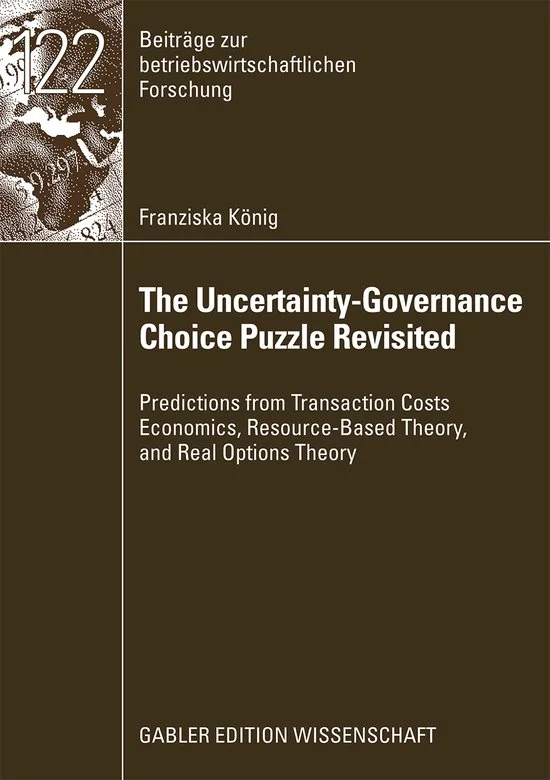
Franziska König examines the nature and effects of uncertainty on governance choice of firms. Despite an innumerable amount of theoretical and empirical efforts that have been undertaken until to date, the relationship between uncertainty and governance choice remains nebulous.
What is the appropriate governance design for operating under uncertain conditions, such as emerging markets and innovative technologies? Although this question has plagued management practice and academic research for years, no unified answer has been found.
Franziska König examines the anatomy of uncertainty-governance choice relationships from different theoretical angles, including transaction costs economics, resource-based theory, and real options theory. The book sharpens single-theoretical explanations and determines their boundaries both conceptually and by providing a comprehensive “vote-counting” analysis of recent empirical research. Recent debates, which argue the optimal governance response to uncertainty, are resolved with three multi-theoretical models. Empirical results of a “policy-capturing” study, conducted in the context of strategic alliances, reveal that managers recognize different uncertainty problems and respond to them by applying distinct “decision policies” along an equity and a coordination dimension of governance.